
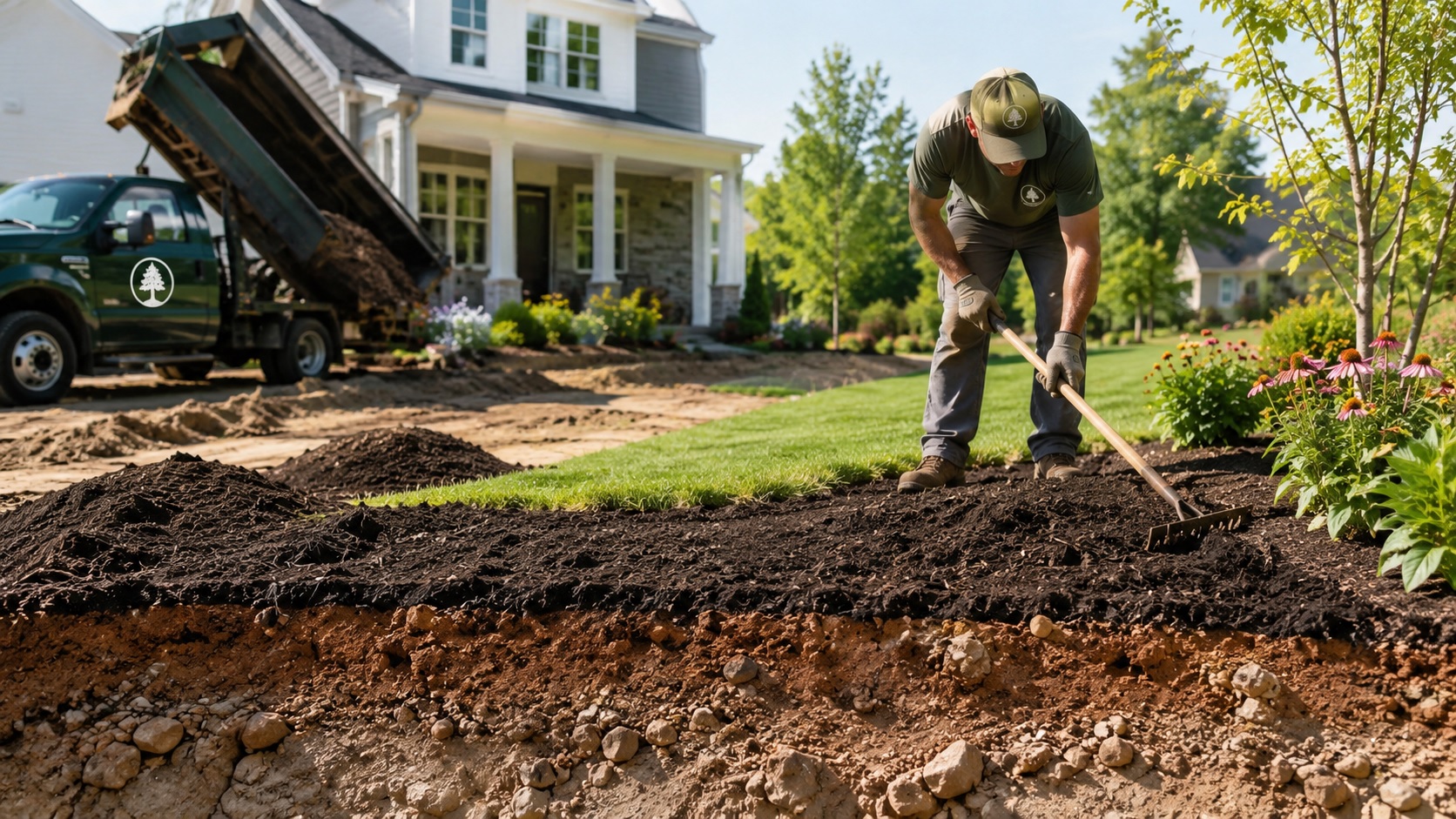
To repair compacted clay soil around a new Connecticut home, first test the soil and loosen the damaged root zone when the ground is moist but not wet. For a bare lawn or new garden area, spread approximately 2 to 3 inches of finished compost and blend it into the upper 6 to 8 inches of soil. Organic matter improves soil structure, air movement, water infiltration, and root growth. Avoid adding a small amount of sand because clay can bind around the sand particles and create an even denser mixture.
A newly built Connecticut home may look finished above ground while hiding a difficult growing environment below it. Construction equipment, excavation, and grading can remove valuable topsoil and compress the remaining clay subsoil.
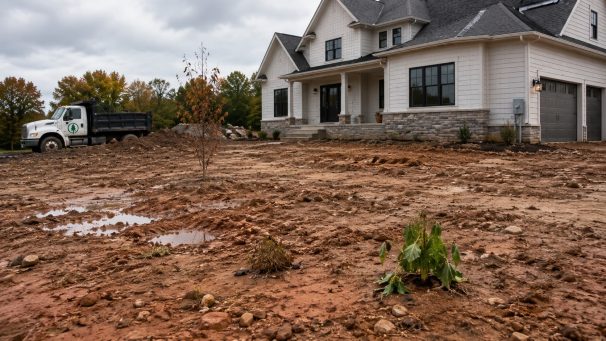
The result is often a rocky yard where grass struggles, water collects, and new plantings fail. At Thrive Farm, we help homeowners rebuild these areas with bulk compost, lawnsoil, and soil blends produced for Connecticut landscapes.
Why New Construction Yards Develop Compacted Clay
Healthy soil contains pores that allow roots, water, and oxygen to move through the ground. When loaders, excavators, delivery trucks, and grading equipment repeatedly cross a property, the pressure pushes soil particles closer together.
Compacted soil has fewer large pores, which reduces both water infiltration and drainage. Roots also have greater difficulty expanding through dense soil, limiting the area available for water and nutrient uptake.
Common signs include:
- Standing water after moderate rainfall
- Clay that feels sticky when wet and hard when dry
- Thin or patchy grass
- Shallow plant roots
- Water running across the surface
- Planting holes that remain filled with water
- Grass seed that sprouts but does not establish
Adding more seed or fertilizer cannot correct a physically damaged root zone. The soil structure must be addressed first.
How Compost Helps Repair Clay Soil
Clay is not naturally infertile. In fact, clay can retain water and nutrients well. Problems develop when the particles become tightly compressed and the soil loses the open structure roots need.
Finished compost adds organic matter that supports soil organisms and helps mineral particles form stable aggregates. These small clusters create spaces where water and air can move more freely.
Compost does not transform clay into another soil texture. It improves the way the existing soil functions by supporting aggregation, nutrient retention, moisture management, and biological activity.
Our Spicy Compost provides organic material for depleted lawns, gardens, planting areas, and construction-damaged soil.
Why Adding Sand to Clay Can Make the Problem Worse
A common recommendation for how to fix clay soil is to mix in sand. The idea sounds reasonable because sandy soils drain quickly, but adding a modest amount of sand to heavy clay rarely creates balanced loam.
Clay particles can coat and bind around the larger sand particles. UConn warns that this mixture may become closer to concrete, while Oregon State University explains that sand can create more difficult soil conditions rather than correcting the texture.
For most residential projects, amending clay soil with compost is more practical than attempting to change the mineral composition with raw sand.
Compacted Clay Soil Solutions for a New Yard
1. Test the Soil
Begin with a professional soil test before applying lime, fertilizer, manure, or large amounts of compost. A test identifies pH, available nutrients, and possible imbalances.
The UConn Soil Nutrient Analysis Laboratory provides testing and recommendations for Connecticut lawns and gardens.
2. Check Moisture Before Working
Clay should be moist enough to crumble, not sticky or saturated. Tilling wet clay can smear the soil, destroy existing structure, and create dense clods after it dries.
Allow the area to drain before using a tiller, broadfork, garden fork, or mechanical soil loosener.
3. Loosen the Compacted Layer
Break open the damaged surface before applying compost. A garden fork may work for a small bed, while a tiller or landscape equipment may be needed for an entire new lawn.
Deep compaction caused by heavy machinery may extend below the normal planting depth. In severe cases, professional mechanical loosening may be necessary before finish grading.
4. Add Finished Compost
For a bare new lawn or garden area, spread approximately 2 to 3 inches of mature compost. Blend it evenly into the upper 6 to 8 inches of existing soil.
University guidance varies based on the soil, crop, and project. Minnesota Extension recommends incorporating 1 to 2 inches into compacted garden soil, while Oregon State University recommends a heavier application when preparing entirely new garden beds. A soil test helps prevent unnecessary overapplication.
For every 1,000 square feet:
- A 2-inch layer requires about 6.2 cubic yards
- A 3-inch layer requires about 9.3 cubic yards
5. Correct the Grade
Compost cannot repair a yard that was graded incorrectly. The finished surface should direct water away from the foundation while avoiding low areas where runoff collects.
Properties that require added elevation may need lawnsoil rather than compost alone. Our topsoil and lawnsoil combine mineral soil with organic materials for grading, lawn establishment, and landscape repair.
6. Protect the Improved Soil
After planting, limit vehicle and foot traffic when the ground is wet. Grass roots, plant roots, mulch, and ongoing organic matter additions can help maintain better soil structure.
Organic mulch also protects the surface from erosion, temperature changes, crusting, and moisture loss.
Should You Use Compost or Lawnsoil?
Choose compost when the existing grade is acceptable and the primary goal is improving organic matter and soil structure.
Choose lawnsoil when the property needs additional volume for grading, filling low spots, or creating a new turf-growing layer.
Our 50/50 Compost Lawnsoil Mix may be appropriate for raised beds and planting projects that need both mineral soil and organic material. Homeowners can also review our guide to the difference between topsoil and compost before ordering.
Bulk Compost Delivery in CT
Repairing an entire construction-damaged yard can require several cubic yards of material. Bagged products quickly become expensive and difficult to transport.
Our bulk compost delivery in CT gives homeowners and landscape professionals access to larger quantities for lawns, gardens, and new construction projects. We serve Simsbury and surrounding Connecticut communities from our local farm.
Before scheduling delivery, measure the project area and determine the planned application depth. Our team can help convert those measurements into cubic yards.
Restore the Soil Before Replanting the Yard
The first step in learning how to fix clay soil is recognizing that the failure may be below the surface. Seed, fertilizer, and extra watering cannot overcome severely compacted subsoil.
By loosening the damaged area, adding the correct amount of finished compost, restoring the grade, and protecting the soil from future compaction, we can create a stronger foundation for lawns and gardens.
Contact Thrive Farm for bulk compost delivery in CT, lawnsoil, or help selecting the right material for a new construction yard.
Frequently Asked Questions
How much compost should be added to clay soil?
A bare new lawn or garden may benefit from approximately 2 to 3 inches of finished compost blended into the upper soil layer. Test the soil first because repeated heavy compost applications can create nutrient imbalances.
Can compost permanently change clay soil?
Compost does not change the percentage of clay in the soil. It improves soil structure, aggregation, air movement, moisture behavior, and biological activity. Ongoing soil protection helps preserve those improvements.
Should compost be tilled into clay?
Compost may be incorporated when preparing a bare new lawn or garden. Avoid tilling wet clay. Established lawns should normally be core-aerated and topdressed rather than tilled.
Can topsoil be placed directly over compacted clay?
Placing a thin layer over hard clay may create a shallow root zone. Better results usually come from loosening the existing ground and creating a gradual transition between the clay and new lawnsoil.