
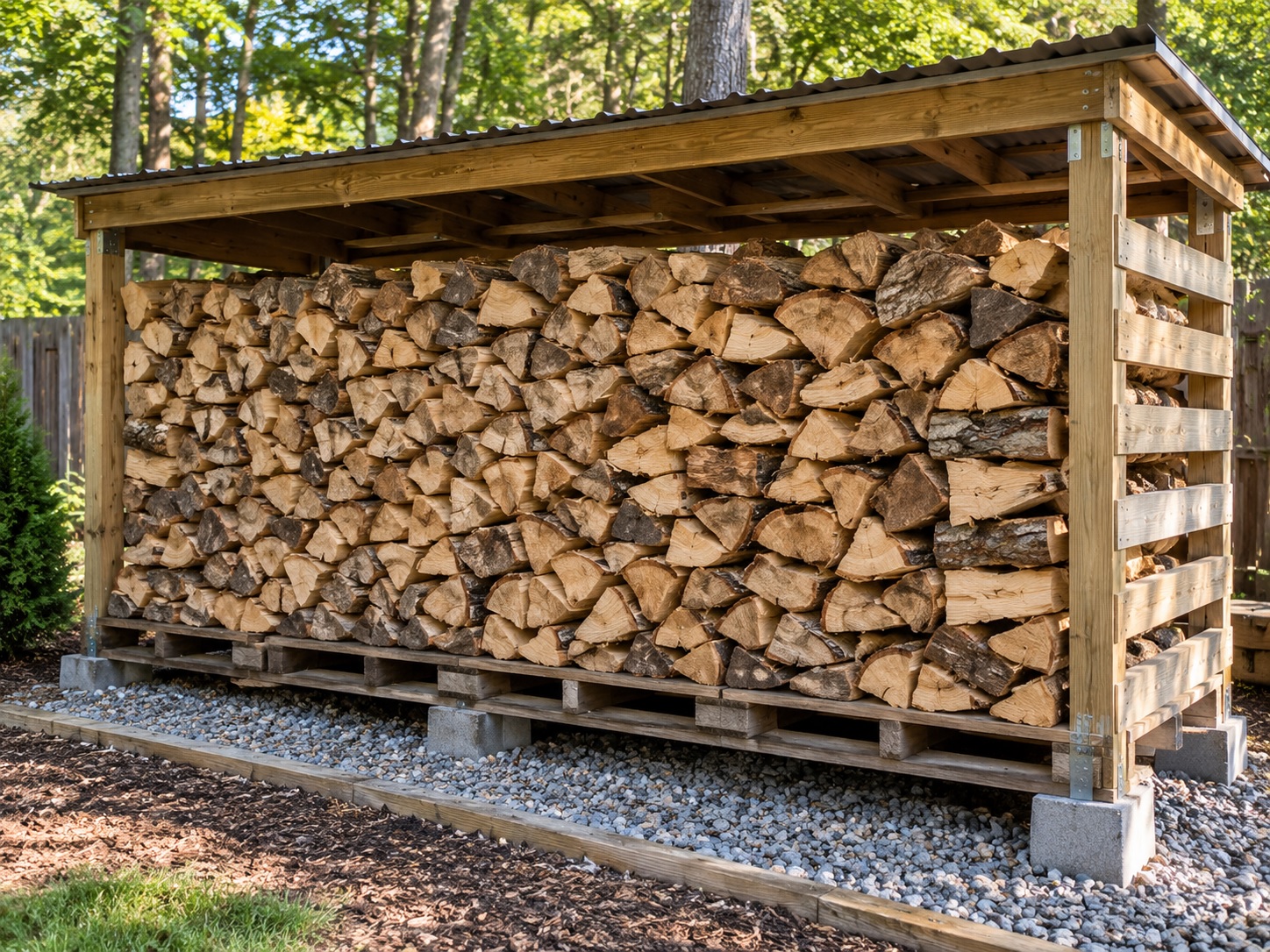
A full cord of firewood equals 128 cubic feet of ranked and well-stowed wood, traditionally measured as 4 feet high × 4 feet deep × 8 feet long. For practical home storage, the footprint depends on log length and stack layout. With roughly 16-inch logs stacked 4 feet high, one cord can occupy about 32 square feet of ground area, plus extra room for airflow and access.
Ordering a full cord of firewood is easy. Finding the right place to put 128 cubic feet of stacked wood sometimes takes more planning.
At Thrive Farm, we recommend choosing and preparing the storage area before delivery arrives, especially when ordering a full cord or more for winter heating.
Understanding cord of wood dimensions also helps homeowners recognize how much firewood they are actually receiving.
What Are the Dimensions of a Cord of Wood?
A full cord contains 128 cubic feet of ranked and well-stowed firewood.
The traditional dimensions are:
4 ft high × 4 ft deep × 8 ft long = 128 cubic feet
NIST identifies this 4 × 4 × 8-foot arrangement as the standard cord example, while also noting that firewood may be stacked in other configurations as long as the total ranked volume equals 128 cubic feet.
For the official measurement standard, see the NIST Handbook 133 firewood guidance.
The important number is therefore 128 cubic feet, not one required stack shape.
How Much Floor Space Does One Cord Need?
If firewood is stacked approximately 4 feet high, a full cord requires roughly:
128 cubic feet ÷ 4 feet high = 32 square feet of footprint
That means several storage layouts can hold the same amount of firewood.
| Approximate Stack Layout | Volume |
|---|---|
| 8 ft long × 4 ft deep × 4 ft high | 128 cu. ft. |
| 16 ft long × 2 ft deep × 4 ft high | 128 cu. ft. |
| 24 ft long × 16 in. deep × 4 ft high | About 128 cu. ft. |
| 32 ft long × 1 ft deep × 4 ft high | 128 cu. ft. |
The actual arrangement will vary according to log length, rack design, and how tightly the firewood is ranked.
How Much Space Does a Cord of 16-Inch Firewood Need?
Thrive Farm’s firewood is generally cut to approximately 16 to 18 inches long for fireplaces and wood stoves.
With 16-inch pieces, three rows placed behind one another create roughly a 4-foot-deep stack.
That gives the familiar:
8 feet long × 4 feet high × approximately 4 feet deep
Another option is a single-row stack.
A row of 16-inch logs stacked 4 feet high would need to extend approximately 24 feet long to represent a full cord:
24 ft × 4 ft × 1.33 ft ≈ 128 cubic feet
This layout can work well along a long shed wall, fence, or dedicated firewood rack where a 4-foot-deep pile would be inconvenient.
How Much Space Does a Half Cord Need?
A half cord equals:
64 cubic feet
One simple arrangement is:
4 ft high × 4 ft deep × 4 ft long
For roughly 16-inch logs stored in a single row, the stack would instead be about:
4 ft high × 12 ft long × 16 in. deep
Thrive Farm offers both half-cord and full-cord firewood quantities, making it easier to match the order to available storage space and seasonal use.
Do We Need More Than 32 Square Feet?
Usually, yes.
Thirty-two square feet represents the theoretical footprint of a cord stacked 4 feet high. A practical firewood area should also provide space for:
- Air circulation
- Loading and unloading
- Walking access
- A pallet or rack
- Wall clearance
- Top covering
- Additional wood if another delivery arrives
Do not design a shed or storage area around the wood volume alone.
A 4 × 8-foot footprint may technically accommodate one cord at 4 feet high, but working around such a tightly packed stack can be inconvenient.
How Should Firewood Be Stored?
Good storage is about more than fitting the wood into the available space.
We recommend keeping firewood:
Off the Ground
Use a rack, rails, pallets, or another suitable raised base.
Keeping the bottom course away from wet soil reduces moisture exposure and improves airflow.
Covered on Top
Protect the top from direct rain and snow.
Avoid completely wrapping the entire stack in an airtight covering.
Open Along the Sides
Air movement helps wood remain dry.
Thrive Farm recommends a dry, well-ventilated storage area with the wood kept off the ground and the top covered while the sides remain exposed to airflow.
Away From Constant Moisture
Avoid low areas where runoff collects or where melting snow continually wets the bottom of the stack.
Should Firewood Be Stored Against the House?
Leaving some space around the stack usually makes storage easier and improves airflow.
It also provides access for checking the wood and keeps a large organic material pile from being pressed directly against siding or other building surfaces.
A freestanding rack, woodshed, or dedicated covered storage area generally provides more flexibility than tightly packing wood against the home.
Can We Stack Firewood Higher to Save Space?
Technically, increasing stack height reduces the required floor area.
For example:
128 cubic feet ÷ 5 feet high = 25.6 square feet
But taller is not always better.
A very high stack may become unstable, harder to load, and inconvenient when removing firewood from the upper courses.
For most residential storage areas, a manageable stack height with good stability and easy access is more useful than maximizing every cubic foot vertically.
Does Wood Species Change Cord Dimensions?
No.
A cord of oak and a cord of softer wood both occupy 128 cubic feet when properly ranked and measured.
What changes is the amount of heat available from that volume because wood density differs by species.
Our related guide to hardwood vs. softwood firewood explains why dense hardwoods such as oak, maple, and ash generally provide more heat per cord than many lower-density woods.
Plan the Firewood Area Before Delivery
Before ordering, measure the available length, depth, and usable stack height.
For a full cord, plan around 128 cubic feet of stacked volume, then allow additional room for airflow and handling.
At Thrive Farm, our firewood delivery includes seasoned hardwood for indoor heating along with other firewood options for Connecticut homeowners. Our standard pieces are generally cut around 16 to 18 inches long and split to manageable sizes.
A little planning before delivery makes stacking faster and helps keep the entire cord dry, accessible, and ready to burn.
Frequently Asked Questions
What are the standard dimensions of a cord of wood?
A traditional full cord measures 4 feet high × 4 feet deep × 8 feet long, totaling 128 cubic feet.
How many square feet does a cord of wood need?
At a 4-foot stack height, 128 cubic feet requires approximately 32 square feet of footprint. Extra space should be allowed for access and airflow.
How long is a cord stacked one row deep?
Using approximately 16-inch logs and a 4-foot stack height, a single-row full cord would extend roughly 24 feet.
What size shed holds one cord of firewood?
The firewood itself requires 128 cubic feet. A practical shed should be larger than the minimum calculated volume so air can circulate and the wood remains accessible.
Is a half cord 4 × 4 × 4 feet?
That arrangement equals 64 cubic feet, which is one-half of a full 128-cubic-foot cord.