
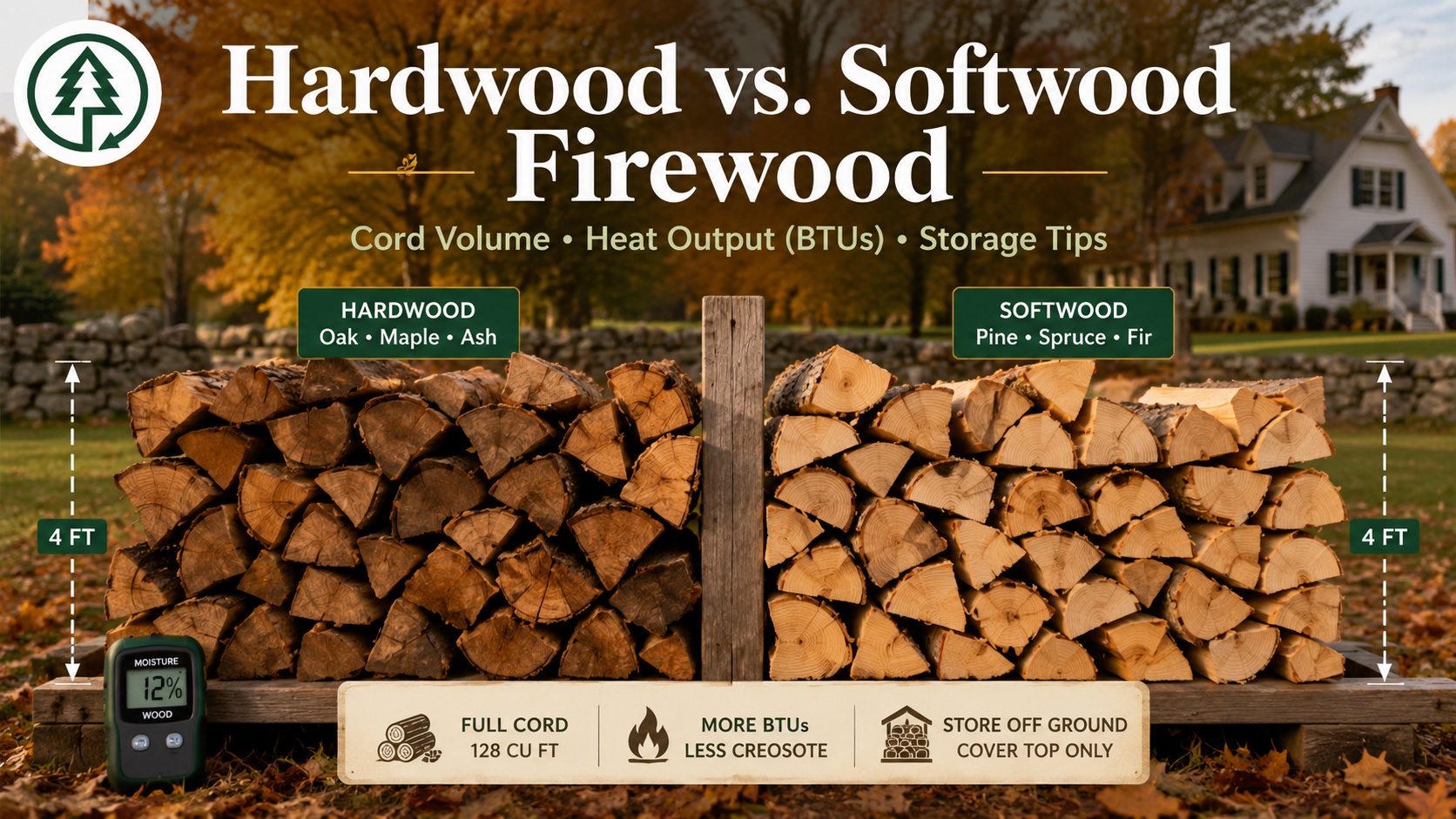
For home heating in Connecticut, we generally recommend dry hardwood because dense species such as oak, sugar maple, and ash provide more heat per cord and longer-lasting coals than many lower-density woods. A legal full cord contains 128 cubic feet of stacked firewood, commonly arranged 4 feet high by 4 feet deep by 8 feet long. Connecticut does not permit terms such as “face cord” when advertising or selling fuel wood because those measurements are not standardized. For efficient burning, moisture matters almost as much as species. The EPA recommends firewood below 20% moisture, while Thrive Farm’s kiln-dried firewood is tested to approximately 15% moisture.
How Big Is a Cord of Wood?
Before comparing hardwood and softwood, we recommend knowing exactly how much wood is being purchased.
A full cord contains 128 cubic feet of ranked and well-stowed wood. A traditional stack may measure:
4 ft. high × 4 ft. deep × 8 ft. long = 128 cubic feet
A half cord contains 64 cubic feet.
A “face cord” usually describes a single row of logs, but its total volume changes with log length. Connecticut law specifically requires fuel wood to be sold using standard cords, fractional cords, cubic volume, or qualifying weight measurements. Terms including “face cord,” “rack,” “pile,” and “truckload” cannot be used as sales measurements.
For Connecticut homeowners comparing firewood prices, measuring actual cord volume can prevent an inexpensive-looking load from becoming an expensive purchase.
Hardwood vs. Softwood: Which Is the Best Firewood for Heat?
The biggest difference is density. Dense wood places more combustible material into the same cord volume, so hardwoods commonly provide more total energy per stacked cord.
For fireplaces and wood stoves, we favor native hardwoods such as oak, maple, and ash because they provide steady heat and longer burns. Softwoods can ignite quickly and work well for kindling, recreational fires, or situations where a shorter fire is preferred.
Firewood BTU Chart
Approximate heat output for properly dried wood includes:
| Firewood Species | Approx. Million BTUs per Cord | General Performance |
|---|---|---|
| White Oak | 25.7 to 27.0 | Very long, hot burn |
| Sugar Maple | 24.0 to 25.0 | Excellent heating wood |
| Red Oak | About 24.0 to 25.3 | Long-lasting heat |
| White Ash | About 23.6 | Easy-burning hardwood |
| Red Maple | About 18.7 to 20.0 | Moderate heat |
| Pine, depending on species | Roughly 19 to 22 | Faster-burning softwood |
Published values vary by species, density, moisture, and testing method, so a firewood BTU chart should be treated as a comparison tool rather than an exact promise of heat output.
For a closer look at ash, see our guide to why Ash firewood works so well during Connecticut winters. Ash Firewood Heating Guide
Seasoned vs. Kiln Dried Firewood
Species matters, but moisture can dramatically change how that wood performs.
Seasoned Firewood
Seasoned wood is naturally air-dried over time. The EPA recommends storing hardwood for roughly a year and checking moisture with a meter before burning. Properly seasoned firewood should reach 20% moisture or less.
Kiln-Dried Firewood
Kiln drying uses controlled heat to remove moisture faster and more consistently than outdoor seasoning.
At Thrive Farm, our kiln-dried firewood is tested at approximately 15% moisture, making it especially useful for homeowners who want wood that lights easily without waiting through another seasoning cycle.
For late fall or winter purchases, kiln-dried hardwood can remove much of the uncertainty surrounding seasoned vs kiln dried firewood.
For ready-to-burn options, explore our kiln-dried hardwood firewood delivery in Connecticut. Kiln-Dried Firewood Delivery
How to Stack and Store Firewood Correctly
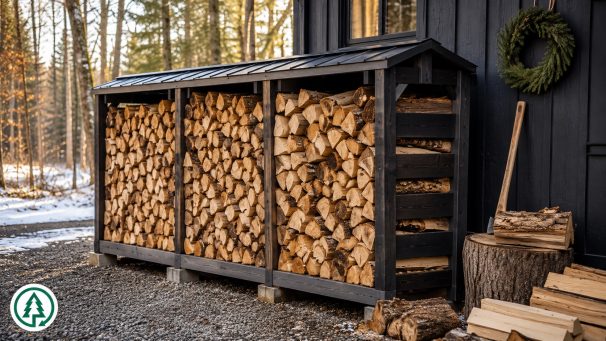
Even excellent hardwood can become difficult to burn when stored poorly. For better airflow and moisture control, we recommend:
- Stack split firewood off the ground using pallets, rails, or a firewood rack.
- Cover the top of the stack, but leave the sides exposed to airflow.
- Split large rounds because smaller pieces dry faster.
- Avoid sealing green or seasoned wood under a tarp on every side.
- Keep older wood accessible so it can be burned before newer deliveries.
- Check moisture on a freshly split surface rather than only testing the outside of a log.
EPA guidance recommends outdoor storage with the wood elevated and the top protected while allowing air to circulate around the sides.
Firewood can also transport invasive insects. Connecticut DEEP identifies firewood movement as a major pathway for pests such as emerald ash borer, and USDA APHIS recommends buying firewood where it will be burned whenever possible.
For additional moisture and burning guidance, review the EPA’s wood-burning recommendations. EPA Best Wood-Burning Practices
Choose Firewood by Heat, Moisture, and Volume
The best firewood for heat is not determined by species alone. We recommend comparing three things before ordering: cord volume, wood density, and moisture content.
Oak, maple, and ash provide excellent heat per cord for Connecticut homes. Properly seasoned hardwood can perform very well when moisture stays below 20%. Kiln-dried hardwood provides an even lower and more predictable moisture level when homeowners need dependable, ready-to-burn fuel.
At Thrive Farm, we make it easier to prepare before temperatures drop with locally supplied hardwood and convenient Connecticut firewood delivery. Order kiln-dried hardwood before peak winter demand and have the stack ready when the next New England cold snap arrives.