
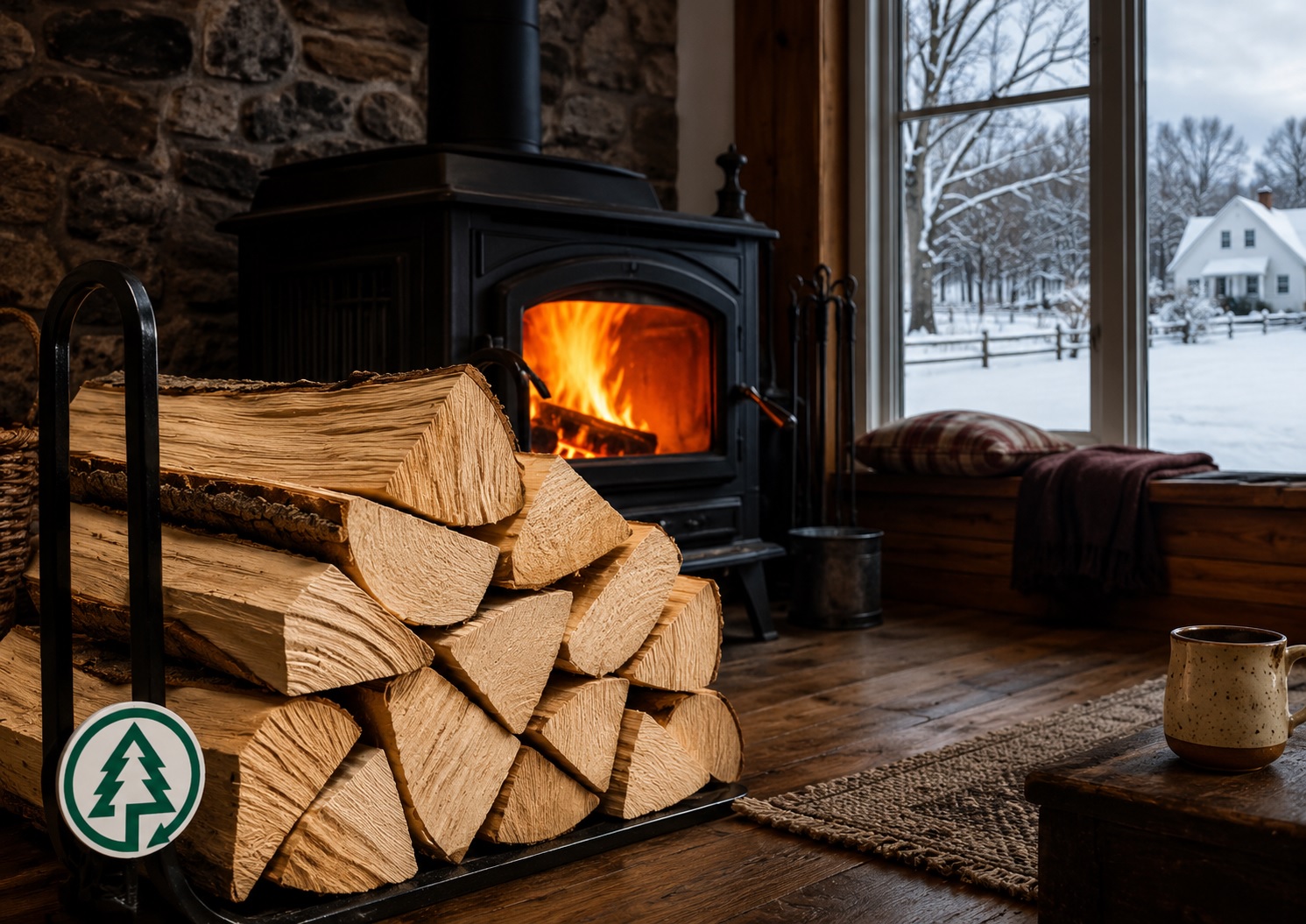
Ash is one of the best firewood choices for Connecticut winters because it delivers heat close to red oak while generally lighting more easily. Published firewood tables place ash at roughly 23 to 24.2 million BTUs per cord, compared with about 24.4 to 24.6 million for red oak. That small heat difference can be outweighed by moisture because dry ash starts faster and wastes less energy evaporating water. The U.S. EPA recommends burning wood below 20% moisture, while Thrive Farm’s kiln-dried firewood is tested to about 15%.
Why Connecticut Winters Change the Firewood Comparison
The best firewood for Connecticut winters is not simply the species with the highest laboratory BTU rating. Homes across Simsbury, Farmington Valley, and greater Hartford face freezing nights, winter thaws, wet fall weather, and damp conditions that can slow natural seasoning.
When a log contains too much water, part of the fire’s energy must evaporate that moisture before producing useful heat. Wet wood becomes harder to ignite, creates more smoke, and encourages smoldering. Extension guidance also connects high-moisture burning with lower heat output and greater creosote buildup.
Ash offers a practical advantage. Oak remains excellent fuel after proper drying, but dense hardwood can require a longer seasoning period. Ash has naturally low moisture compared with many other hardwood options and responds well to controlled drying, making it easier to prepare for dependable winter use. Thrive Farm’s limited-supply ash currently measures approximately 20% to 25% moisture and was harvested standing dead.
Ash Firewood BTU vs Oak in CT
| Hardwood | Approximate Heat per Cord | Starting Characteristics |
|---|---|---|
| Ash | 23 to 24.2 million BTUs | Fair to moderate ignition, few sparks |
| Red oak | 24.4 to 24.6 million BTUs | More difficult to start, few sparks |
| Sugar maple | About 23.7 million BTUs | Moderate ignition |
| Red maple | About 21.2 million BTUs | Easier ignition |
Published heat values vary slightly by ash species, wood density, moisture, and testing method. However, the overall comparison remains consistent: ash produces nearly as much heat per cord as red oak while generally being easier to start.
Ash gives up very little theoretical heat compared with red oak. In a Connecticut home, the drier load may deliver more usable warmth because less energy is spent removing moisture. This makes ash valuable for homeowners trying to reduce reliance on electric resistance heat or heating oil during peak winter.
Our ash firewood is available in limited supply and currently ranges from about 20% to 25% moisture. For a lower ready-to-burn level, our kiln-dried firewood is tested to approximately 15% moisture.
Firewood Moisture Content CT Homeowners Should Follow
For firewood moisture content, CT homeowners should use 20% as the key threshold. The EPA states that wood burns best below 20% moisture and recommends checking a freshly split face with a moisture meter. Wood should be raised off the ground, covered only on top, and left open on the sides for airflow.
Kiln drying provides greater consistency when fall rain, shade, limited storage, or a late-season purchase makes home seasoning unreliable. Properly dried ash supports faster ignition, a hotter and steadier fire, less visible smoke, and lower creosote potential.
Homeowners storing wood for a future heating season can review our firewood stacking and storage guide for airflow, elevation, cover, and stack placement recommendations.
Ash for Fireplaces vs Wood Stoves
Open Fireplaces
Open hearths lose more heat and provide less combustion control than modern heating appliances. Dry ash helps by catching quickly and producing a steady flame without a long warm-up period. Thrive Farm recommends kiln-dried wood for fireplace users because its lower moisture supports easier lighting and stronger combustion.
EPA-Certified Inserts and Wood Stoves
EPA-certified wood stoves and fireplace inserts are designed for improved efficiency, lower smoke, and reduced firewood consumption compared with older heaters or traditional fireplaces. Ash works well in these appliances because it provides strong heat without the difficult starting characteristics associated with some denser hardwoods.
Annual chimney inspection and cleaning remain important. Seasoned wood and hot fires can help reduce creosote formation, but they do not replace proper appliance and chimney maintenance.
Emerald Ash Borer and Connecticut Firewood Rules
Emerald ash borer has spread throughout Connecticut, and infested firewood has been a major pathway for moving the pest. Connecticut DEEP limits the movement of all hardwood firewood, not only ash. Anyone transporting firewood within the state must carry documentation showing its origin and destination, which may be completed through the state’s self-issued firewood transportation certificate.
Buying locally sourced firewood reduces the chance of carrying invasive forest pests over long distances. Kiln-dried wood provides a more predictable burning product, but buyers should still follow current Connecticut transport and documentation rules.
Choose the Right Ash Firewood for the Heating Season
For December through March heating, ash offers a strong balance of heat output, ignition, drying performance, and cleaner operation. Homeowners searching for kiln dried ash firewood near me should compare verified moisture content, log size, delivery area, and supply availability rather than choosing by species alone.
At Thrive Farm, we provide native hardwood firewood delivery in Connecticut along with limited-supply ash and kiln-dried options. Ordering before the next extended cold period provides time to stack the wood correctly and keep it protected before use.