

To level a bumpy lawn, we start by identifying low spots, mowing the grass shorter than normal, loosening compacted areas, and spreading a thin layer of screened lawnsoil or a compatible lawn leveling soil mix. For established grass, shallow applications work best because the grass blades need to remain exposed. Deeper depressions should be filled gradually or repaired separately with soil and new seed. Sand can be useful in certain sandy or well-drained lawns, but straight sand is not the best universal solution for heavy Connecticut soils.
At Thrive Farm, we recommend using a screened lawnsoil that adds enough mineral soil to correct the grade while still supporting grass roots.
Why Does a Lawn Become Uneven?
Before learning how to level a bumpy lawn, we first look for the cause.
Common problems include:
- Soil settling after construction
- Freeze and thaw cycles
- Heavy foot or equipment traffic
- Poor drainage
- Animal activity
- Tree root growth
- Thin topsoil
- Erosion after heavy rain
A few shallow depressions usually need simple topdressing. Large holes, drainage channels, or major grade changes may require more extensive soil work before grass can be restored.
What Is the Best Lawn Leveling Soil Mix?
For most residential lawns, we prefer a blend containing screened topsoil or lawnsoil with some finished compost.
Our Thrive Farm Lawnsoil combines native topsoil and compost and is screened to 1/2 inch, making it easier to rake across turf and into low areas.
A typical DIY lawn leveling soil mix may contain:
- Screened lawnsoil for structure and volume
- Finished compost for organic matter
- A limited amount of sand when the existing soil already has a sandy texture
Avoid assuming more sand automatically means better drainage. Heavy clay soil mixed improperly with sand can become harder and more difficult to manage.
The UConn Home & Garden Education Center recommends choosing topdressing soil with physical characteristics similar to the existing soil to reduce problems caused by layering.
Step 1: Find the High and Low Spots
Walk across the lawn and mark depressions with landscape flags.
A long board, string line, or lawn leveling rake can help reveal subtle dips that are difficult to see from standing height.
Check whether water collects in these areas after rain. Persistent standing water may indicate a drainage problem rather than a simple surface-leveling problem.
Step 2: Mow the Lawn Shorter
Mow slightly shorter than normal, but never scalp healthy turf.
Remove leaves, sticks, excessive thatch, and loose debris. The leveling material needs to reach the soil surface rather than resting on top of long grass.
Step 3: Aerate Compacted Lawn Areas
If the ground feels hard or compacted, core aeration can improve the result.
Aeration creates openings that allow water, air, seed, and organic material to move into the root zone. It can be especially useful before leveling lawns damaged by construction equipment or repeated traffic.
Step 4: Spread Lawnsoil Across Low Areas
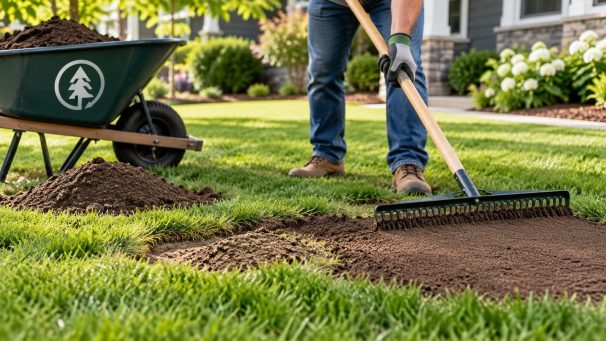
Place small piles of lawnsoil throughout the uneven section.
Use the back of a landscape rake, leveling rake, or drag mat to distribute the material.
For established turf, start with roughly 1/4 inch across the surface. Shallow depressions can receive more material, but the existing grass blades should still remain visible.
For deeper holes, add soil gradually rather than burying several inches of healthy turf at once.
Step 5: Work the Soil Between the Grass Blades
Rake the material back and forth until the soil settles around the crowns of the grass.
The goal is not to create a layer of dirt over the lawn. We want the material to fill depressions while allowing existing grass to continue receiving sunlight.
This gradual approach is also useful when trying to determine how to fix uneven grass without removing the entire lawn.
Step 6: Overseed Bare or Thin Areas
Low areas often contain weak or damaged turf.
After leveling, spread grass seed suited to the property’s sunlight, traffic, and moisture conditions. Lightly rake the seed into the new soil to improve seed-to-soil contact.
For more information on choosing between compost and soil for this process, see our guide to topdressing lawns with compost vs. topsoil.
Step 7: Water and Let the Soil Settle
Water gently after leveling.
Keep newly seeded areas consistently moist during germination. After a few watering cycles and rain events, inspect the lawn again.
Some depressions may need a second light application because fresh soil naturally settles.
How Much Topsoil Do You Need for Lawn Leveling?
Use this formula:
Square Feet × Depth in Inches ÷ 324 = Cubic Yards
For example:
2,000 sq. ft. × 0.25 inch ÷ 324 = about 1.54 cubic yards
Add a small allowance when filling multiple low spots.
Ordering topsoil for lawn leveling in bulk can make larger projects easier and more consistent than working with dozens of small bags.
Can a Severely Uneven Lawn Be Fixed with Topdressing?
Topdressing works best for shallow dips and gradual surface correction.
Consider more extensive repair when:
- Depressions are several inches deep
- Water remains after storms
- Tree roots are lifting large sections
- Soil has settled around foundations
- The lawn needs major regrading
Trying to correct a major grade problem with repeated surface applications can waste material without fixing the underlying cause.
Smooth Out Your Lawn with Bulk Lawnsoil from Thrive Farm
A smoother lawn starts below the grass.
At Thrive Farm, we produce screened lawnsoil suited for lawn repair, low-spot filling, reseeding, and other Connecticut landscaping projects. Instead of covering healthy turf with heavy layers, we recommend correcting uneven areas gradually and giving grass time to grow through each application.
For homeowners planning a larger leveling project, bulk lawnsoil provides the volume needed to restore low areas while creating a better growing environment for new and existing grass.
Order bulk Lawnsoil from Thrive Farm for pickup or delivery and start building a smoother, healthier lawn.