
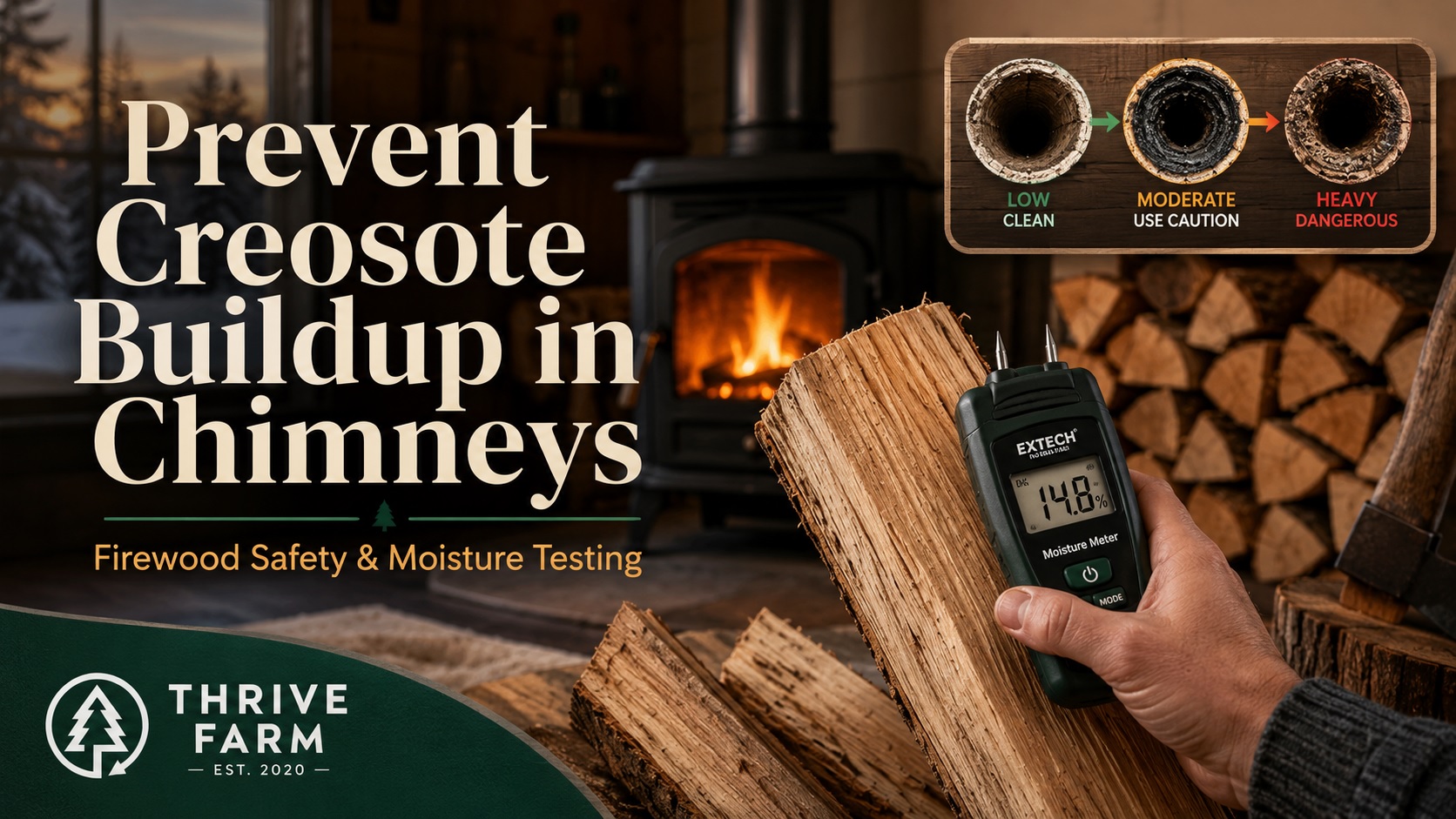
The best way to reduce creosote buildup in a chimney is to burn properly dried firewood, maintain strong combustion, avoid smoldering fires, and have the chimney inspected regularly. At Thrive Farm, we recommend checking firewood with a firewood moisture meter before bringing it to the stove or fireplace. The U.S. EPA recommends wood at 20% moisture content or less and notes that wet wood produces less heat while creating more smoke and creosote. Restricted airflow, unseasoned firewood, and cooler chimney temperatures can also accelerate deposits inside the flue.
Why Wet Firewood Creates More Creosote
Creosote forms when smoke and other combustion byproducts travel into a cooler chimney, condense, and stick to the flue walls. The resulting residue can range from flaky deposits to hardened, shiny glaze, and all forms can be combustible.
Wet or green firewood makes the problem worse.
Before wet wood can burn efficiently, much of the fire’s energy must first evaporate water trapped inside the log. That lowers combustion and flue temperatures while increasing smoke production.
The result can be:
- More visible smoke
- Lower heat output
- Harder fire starting
- More wood consumed for the same heat
- Faster creosote accumulation
- Greater chimney maintenance requirements
For homeowners looking for consistently dry fuel, our kiln-dried firewood is tested at approximately 15% moisture content, comfortably below the EPA’s 20% guideline.
Understanding Stage 1, Stage 2, and Stage 3 Creosote
Chimney professionals commonly describe creosote buildup by progressively harder forms.
Stage 1: Flaky or Soot-Like Deposits
Early creosote may appear as loose, black soot or flaky residue. This form is generally easier for a chimney professional to remove through standard mechanical sweeping.
Finding some residue does not mean the chimney should be ignored. Continued poor burning practices can allow deposits to become progressively harder.
Stage 2: Crunchy or Tar-Like Creosote
More advanced deposits may become thicker, harder, sticky, or tar-like.
This often points toward repeated exposure to cooler, smoky fires. Burning wet wood or reducing stove airflow too aggressively can contribute to these conditions.
Stage 3: Glazed Creosote
The most concerning form is often described as glazed creosote. It can appear dark, shiny, and extremely hard.
This material can be difficult to remove through routine brushing alone and should be evaluated by a qualified chimney professional rather than treated as a DIY cleaning project.
CSIA notes that creosote can appear crusty, flaky, sticky, tar-like, or shiny and hardened. All forms are combustible.
How to Test Firewood Moisture Content Correctly
Learning how to test firewood moisture content removes much of the guesswork from deciding whether a log is ready to burn.
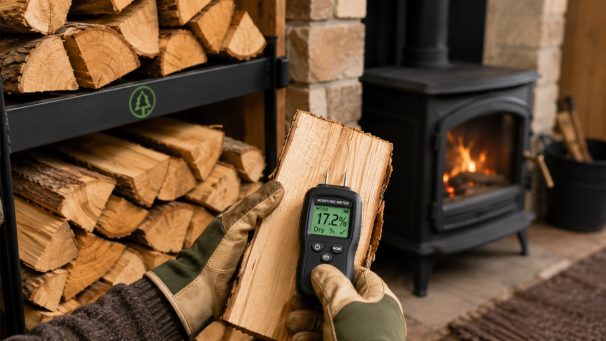
A basic pin-style wood moisture meter is one of the easiest tools to use.
1. Select a Representative Log
Do not test only the driest-looking piece on top of the pile. Choose several logs from different parts of the stack.
2. Split the Log
Testing only the exterior can produce a misleading reading because the outside surface dries before the center.
Split the log immediately before testing.
3. Test the Newly Exposed Face
Press the meter probes firmly into the freshly split interior surface and follow the meter manufacturer’s directions.
EPA guidance specifically recommends testing the newly split side and inserting the probes into the wood grain.
4. Look for 20% Moisture or Less
For indoor burning, we recommend staying at or below 20% moisture content.
The EPA identifies less than 20% as the preferred level for dry firewood and notes that properly dried wood produces a hotter, cleaner fire with less smoke and creosote.
For more help keeping wood dry after delivery, see our guide to storing firewood safely.
Do Stove Damper Settings Affect Creosote?
Yes. Airflow has a major effect on combustion.
A wood stove needs enough oxygen to burn fuel cleanly. Closing a damper or air control too far can create a slow, smoky fire that sends more unburned combustion products into the chimney.
CSIA identifies restricted air supply, including closing stove dampers or air inlets too soon or too much, as a condition that can accelerate creosote buildup.
We recommend starting with adequate airflow to establish a hot fire, then adjusting the appliance according to its manufacturer’s instructions. Avoid trying to extend burn time by starving the fire of oxygen.
Exact air-control settings vary by stove, so the appliance manual should always take priority.
Better Wood-Burning Habits for a Cleaner Chimney
A safer winter-burning routine does not need to be complicated.
We recommend:
- Burn dry, seasoned or kiln-dried firewood
- Test questionable logs with a moisture meter
- Start with dry kindling and a small hot fire
- Maintain adequate airflow
- Avoid consistently smoldering fires
- Do not overload the firebox
- Store wood off the ground with airflow around the stack
- Have the chimney and wood-burning appliance inspected regularly
The EPA also recommends annual chimney inspection and burning dry wood at less than 20% moisture.
For additional moisture-meter guidance, see the U.S. EPA firewood moisture testing resource.
Burn Drier Firewood This Winter
Preventing creosote starts before the first match is struck.
Dry fuel, proper airflow, good storage, moisture testing, and professional chimney maintenance all work together to create a hotter, cleaner fire.
At Thrive Farm, we supply Connecticut homeowners with seasoned and kiln-dried firewood for fireplaces and wood stoves. When moisture matters, choosing properly dried wood can mean easier starts, stronger heat output, less smoke, and fewer conditions that encourage creosote buildup.
Stock up before cold weather arrives and choose firewood that is ready for efficient winter burning.